
5 Tips to Organize Scholarship Materials to Save Time
The scholarship process involves a lot of information. Your student may submit dozens of applications, each requiring a variety of scholarship materials, each and every year. Simply keeping track of all of that can quickly become overwhelming, if not completely unmanageable, unless they take the proper steps.
For many scholarships, your student will need to track:
- Login IDs
- Passwords
- Application Forms
- Essays
- Letters of Recommendation
- Test Scores
- Transcripts
On top of that, your student also needs to stay on top of any deadlines and scholarship committee contact information. And, to make matters more complex, some committees will also ask for sample portfolios and other scholarship materials.

The sheer volume of scholarship materials increases shockingly quickly. Your student can end up with hundreds of documents easily during their first year of applying alone.
Without a strong organizational paradigm, merely locating the right scholarship materials can be a challenge. Your student may spend valuable minutes or hours trying to track down the document they need, wasting time that could be put toward completing other scholarship applications.
If your student wants to save time during their scholarship hunt, here are five tips that can help them stay organized.
1. Choose a Naming Convention for Scholarship Materials
When your student saves a file, they have to name it. If they default to what their computer automatically assigns, a text document’s name is usually based on the first line of text the system can read. For images and scans, their computer may use the date and assign a number, or follow a number sequence.
In many cases, default file names aren’t ideal. They don’t give your student any idea of what the documents or other scholarship materials are, so they usually have to open the files to figure out.
Instead of using the default option, your student should create a naming convention that provides them with more details about what is in the file. They may want to use an abbreviation for the scholarship’s name, the year it was created, and an indication of what the document or image represents.
For example, if your student is submitting information for a scholarship (we’ll call it the “XYZ Company’s Excellence Scholarship”) this year, and the file is a copy of their application, they may want to save that file as “XYZ-2018-App” for ease of reference. Then, if they also submitted an essay, that file could be “XYZ-2018-Essay” or “XYZ-2018-Essay1” if more than one essay is required.
While they don’t have to follow that convention exactly, choosing one that makes identifying what a file is without having to open it can help significantly with organization, so it’s worth selecting a pattern that works for them.
We also recommend saving new drafts of essays as a new version. For example, it could be “XYZ-2018-Essay1_v1” for the first draft, “XYZ-2018-Essay1_v2” for the second version, and so on. Creating them as a new file helps prevent accidentally saving over updated copies (been there, done that!)
2. Use Cloud Storage for Saving Scholarship Materials
Today, nearly everyone has access to some cloud storage. Every Google account holder gets access to some for free as well as most Amazon shoppers. Dropbox also has a free option, so your student can sign up for an account there if they prefer, and Microsoft users commonly have access to cloud storage through the OneDrive feature.
Which option your student selects for their scholarship materials isn’t particularly relevant. They all offer a reasonable amount of storage (though some provide more than others) and similar levels of security. However, it’s helpful if the solution they choose also has a desktop feature, allowing it to show in their computer’s file explorer.
Cloud storage provides a number of benefits over saving files to a computer, including:
- Freeing up hard drive space on your student’s computer
- Access through any internet-enabled computer (and often mobile devices as well)
- Automatic backups and redundancy, ensuring a crash doesn’t wipe out their files
- Desktop access and easy searching
Ultimately, cloud storage is highly accessible, incredibly secure, and very convenient. Plus, if the solution comes with a desktop feature, it’s easy to search for files right from your student’s computer.
I personally have used Dropbox for nearly a decade. I now pay for 1 TB of data space because I back EVERYTHING up on it. You can install it as a folder right on your computer just like Google Drive.
Don’t have a Dropbox account? Click here to get started.
If you and your student are working on the scholarship process, make sure you don’t miss our free scholarship training. It’s about 45 to 60 minutes long and I cover exactly where you can find more scholarships your student is actually eligible for and are legitimate. Grab your spot here: 6 Steps to Quickly Securing Scholarships for College.
3. Choose a Scholarship Materials File Structure
Once the cloud storage is available, your student shouldn’t just start dumping every file into a single folder. If they end up with hundreds of documents, scrolling through the list isn’t going to be a fun experience.
Instead, it’s smart to create a multilevel folder structure for scholarship materials.
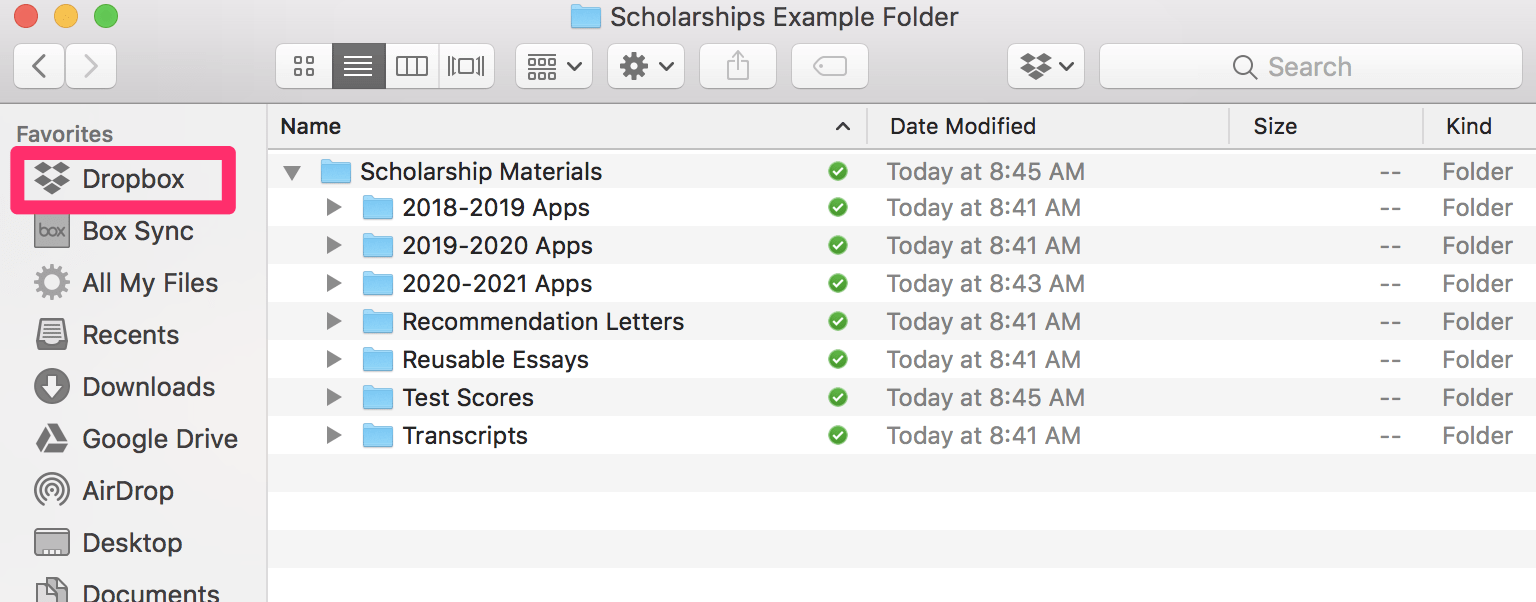
Your student can begin by creating a starting file called “Scholarship Materials.” Then, within that folder, they can create a new folder for “2019-2020 Applications” to represent the upcoming school year. Inside that folder should be subfolders, one for each scholarship they try to land. And, as they apply for scholarships, those folders will be the places where they save those documents and other files.
Additionally, inside the main “Scholarship Materials” folder, they can create a separate folder for certain files that they collect in advance. For example, they could label one “Letters of Recommendation,” and keep scanned copies of all of the letters there. A “Test Scores” folder can hold details from their ACT, SAT, or any other exam. Then, when they apply to another scholarship, they know exactly where the primary copies of those documents live.
When it comes time to prepare for the 2020-2021 school year, they’ll create a “2020-2021 Applications” folder inside the “Scholarship Materials” folder, and repeat the process of creating new subfolders for each scholarship.
See the example of how to set up a scholarship folder below (this is inside our Dropbox folder):
4. Set Up Calendar Reminders for Critical Deadlines
As your student searches for scholarships, they might not apply to them all right away. Instead, they may bookmark the page and figure they can get back to it later, allowing them to continue their search.
While that approach to managing a scholarship search is acceptable, it doesn’t necessarily ensure that they will actually come back and apply. If your student wants to make sure they don’t miss their chance, then they need to take an extra step.
As they identify a scholarship with potential, they need to jump into a calendar and create a reminder. Have them create a new appointment on the day the scholarship application is due and, in the notes section, add a copy of the link to the website. Then, schedule an alert for one week before the deadline and another for the day before the deadline, ensuring they get two reminders to handle their application.
Related articles:
5. Create a Master Spreadsheet for Credentials and Contact Information
Keeping track of login credentials and contact information alone can be a challenge. Even with technologies like password keepers, ensuring that all of the information is available should a technical issue prevent them from accessing saved login details is a must.
One of the easiest methods for backing up this information is to create a master spreadsheet. Your student can list the name of all of the scholarships they apply to, a link to the website, login IDs and passwords, and contact email addresses for future follow-up. They can even add links to folders in their cloud drive or computer, making it easy to reach the right information from each application. This puts access to all of their scholarship materials in a single place, which can be beneficial.
However, many would also (rightly) say that this creates a level of risk. After all, having your login ID and password in a single place could be dangerous if someone else accessed the master spreadsheet.
As a precautionary measure, it’s usually wise to password protect this document and, if your student absolutely must save this password somewhere, choose a place that isn’t the cloud drive. That way, the file containing their credentials and links to their scholarship materials is encrypted and practically inaccessible to anyone who doesn’t have the password.
By following the tips above, your student can make sure their scholarship materials are organized at all times, increasing the odds that they will be able to find critical files when they need them most.



Extremely helpful info.